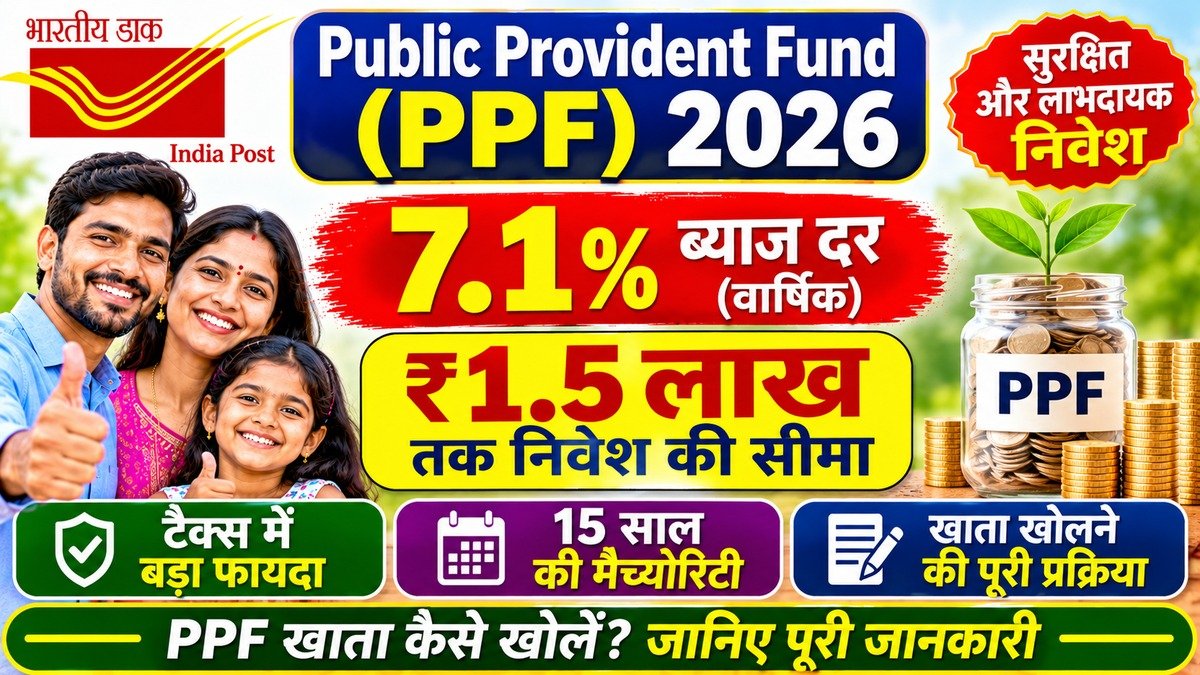
The Public Provident Fund (PPF) is a long-term government savings scheme for people who want to build savings over several years. For October–December 2026, the notified interest rate is 7.1% per year, compounded annually. You can deposit from ₹500 to ₹1.5 lakh in a financial year, and the normal maturity period is 15 years from the end of the financial year in which you open the account.
What is the Public Provident Fund?
The Public Provident Fund is a statutory small-savings scheme of the Government of India. It is governed by the Public Provident Fund Scheme, 2019.
It is designed for individuals who want to save regularly over a long period. You do not need to be a government employee to open an account. Salaried employees, self-employed people and other eligible resident individuals can use it.
You can open a PPF account at an eligible post office or authorised bank. A parent or legal guardian can also open an account on behalf of a minor child. indiapost.gov.in+1
Public Provident Fund interest rate in 2026
The current interest rate for PPF is:
7.1% per annum
Applicable from 1 October to 31 December 2026
The Ministry of Finance kept small-savings interest rates unchanged for the third quarter of FY 2026-27. PPF interest is compounded annually and credited to the account at the end of the financial year.
The rate is not guaranteed to remain at 7.1% for the entire 15-year period. The government reviews small-savings rates periodically, so future rates may change. Department of Economic Affairs+2
Public Provident Fund deposit limits
The scheme has minimum and maximum annual deposit limits.
| Deposit rule | Amount |
|---|---|
| Minimum deposit per financial year | ₹500 |
| Maximum deposit per financial year | ₹1,50,000 |
| Deposit amount | In multiples of ₹50 |
| Normal maturity period | 15 years |
You can deposit money in one lump sum or in instalments during the financial year. You do not have to deposit the same amount every month.
The ₹1.5 lakh annual ceiling includes deposits into your own PPF account and accounts you open on behalf of eligible minor children. An individual cannot open multiple personal PPF accounts to multiply the limit. Joint PPF accounts are not permitted. indiapost.gov.in+1
Main benefits of PPF
1. Long-term savings discipline
The 15-year structure encourages people to build savings gradually. You can deposit according to your financial situation, as long as you meet the minimum annual requirement.
2. Government small-savings scheme
PPF is a statutory government savings scheme. Its interest rate is notified by the government and is not linked to daily share-market movements.
3. Interest compounding
Interest is compounded annually. Over a long period, interest can build on the accumulated balance, helping your savings grow.
The actual maturity value depends on the deposits you make and the interest rates notified during the account’s life. No fixed maturity amount should be assumed unless the future rate and deposit pattern are known.
4. Loan facility
A PPF account holder may apply for a limited loan against the account during the prescribed period. The rules generally allow a loan during the period beginning after one year from the end of the financial year of the initial subscription and before the expiry of five years from that year.
The permitted loan amount is calculated using the balance in the account under the scheme formula. It is not an unlimited loan facility. indiapost.gov.in
5. Partial withdrawal facility
Partial withdrawal is available after the prescribed waiting period. Under the scheme, the first withdrawal can generally be made after five years have expired from the end of the financial year in which the account was opened.
The maximum withdrawal is calculated using the balance in the account under the prescribed formula. Withdrawals are limited to the permitted frequency and cannot be treated like unrestricted savings-account withdrawals. indiapost.gov.in
Who can open a PPF account?
The main eligibility conditions are:
- A resident Indian individual can open an account.
- A guardian can open one account on behalf of an eligible minor.
- Only one account can be held by an individual in their own name.
- Joint accounts are not allowed.
- Hindu Undivided Families and companies cannot open a PPF account under the individual scheme.
- Non-resident Indians cannot open a new PPF account.
If an individual becomes a non-resident after opening an account, separate rules apply. Check the current rules with the bank or post office rather than assuming the account can continue in the same way. indiapost.gov.in+1
Documents required to open a PPF account
Keep these documents ready:
- PAN card.
- Aadhaar or another accepted identity document.
- Proof of address.
- Recent passport-size photograph.
- Initial deposit amount.
- Bank account details, where required.
- Birth certificate and guardian information for a minor’s account.
- Date-of-birth proof for a minor, as required by the account-opening form.
The official PPF account-opening form includes the applicant’s name, date of birth, Aadhaar, PAN, address, contact details and KYC document information. The bank or post office may request additional documents under current KYC rules. indiapost.gov.in
How to open a Public Provident Fund account
You can open a PPF account through an eligible post office or authorised bank.
Step 1: Choose where to open the account. Select a post office or bank that offers PPF accounts.
Step 2: Request the PPF account-opening form. Ask for the current form and read the declaration carefully.
Step 3: Complete your details. Enter your name, address, PAN, Aadhaar and other requested information.
Step 4: Select the account type. Choose an individual account or an account opened through a guardian for a minor.
Step 5: Provide nomination details. Add nominee information according to the prescribed form.
Step 6: Attach KYC documents. Submit your PAN, identity proof, address proof and photograph.
Step 7: Make the initial deposit. Deposit at least ₹500 to open the account.
Step 8: Verify the account. Check your name, account number and deposit entry.
Step 9: Keep your passbook or account statement. Save it for future deposits and withdrawals.
Step 10: Make regular annual deposits. Deposit at least the minimum amount during every financial year to keep the account active.
Some banks offer digital account-opening or deposit facilities. Availability depends on the bank’s current services. India Post also provides online deposit and account-information services for eligible post-office savings customers. India Post+1
PPF maturity and extension rules
A PPF account normally matures after 15 years from the end of the financial year in which it was opened.
For example, an account opened during FY 2026-27 reaches its normal maturity after the prescribed 15-year period calculated from the end of that financial year.
After maturity, you have options:
- Close the account and withdraw the eligible balance.
- Continue the account without making new deposits, subject to the rules.
- Extend the account with deposits for another block of five years by submitting the prescribed request within the allowed period.
If you want to keep depositing after maturity, follow the extension procedure on time. Deposits made without a valid extension may be treated as irregular. indiapost.gov.in
Tax benefits and important points
PPF is widely known for its favourable tax treatment. Interest and maturity proceeds receive tax-exempt treatment under the applicable rules.
However, the tax benefit on contributions depends on the tax regime and the current income-tax law. Do not assume that every contribution automatically gives a deduction under every tax regime.
Before investing for tax reasons, check the current rules with the Income Tax Department or a qualified tax professional. India Post+1
Common mistakes to avoid
- Depositing less than ₹500 in a financial year.
- Depositing more than ₹1.5 lakh and assuming the excess will earn interest.
- Opening a second personal account.
- Trying to open a joint account.
- Assuming the interest rate is fixed for 15 years.
- Forgetting the extension deadline after maturity.
- Expecting unrestricted withdrawals during the lock-in period.
- Depositing money into an account without checking whether it has become discontinued.
If you miss the minimum annual deposit, the account can become discontinued. The scheme permits revival during the maturity period by paying the prescribed fee and minimum-deposit arrears. indiapost.gov.in
An illustrative example
Suppose a 30-year-old salaried person opens a PPF account and deposits ₹5,000 every month. The annual deposit is ₹60,000, which is below the ₹1.5 lakh ceiling.
The person continues depositing for the required period. Interest is credited according to the rates notified by the government in each applicable period.
The final balance depends on future rates and the timing of deposits. The example shows how regular saving can build a long-term fund; it does not promise a specific maturity amount.
Frequently asked questions
1. What is the current PPF interest rate?
The rate is 7.1% per year for October–December 2026, with annual compounding.
2. What is the minimum deposit?
You must deposit at least ₹500 in a financial year.
3. Can I deposit ₹1.5 lakh in one payment?
Yes. The scheme allows a lump-sum deposit or instalments, subject to the annual limit.
4. Can I withdraw money before 15 years?
Limited loans and partial withdrawals are allowed after the prescribed waiting periods. Full premature closure is permitted only under specific conditions.
5. Can an NRI open a new PPF account?
No. A non-resident Indian cannot open a new account under the PPF scheme. indiapost.gov.in+1
Open your PPF account through an authorised institution
Compare your savings needs with the 15-year term, collect your PAN and KYC documents, and visit an eligible post office or bank. For the current rate and official scheme information, visit the India Post savings schemes page.
Leave a Reply