Category: Uncategorized

  • PM Vidyalaxmi Education Loan 2026: Eligibility, Interest Subsidy, Documents and Online Apply

    PM Vidyalaxmi Education Loan 2026: Eligibility, Interest Subsidy, Documents and Online Apply

    A lack of money should not stop a deserving student from pursuing higher education. The PM Vidyalaxmi education loan scheme helps students admitted to selected quality higher education institutions in India access collateral-free and guarantor-free education loans. Eligible students can also receive interest support based on family income. Under the scheme, the government provides a 75% credit guarantee to banks for eligible loans up to ₹7.5 lakh, while qualifying students from families earning below ₹8 lakh annually can receive a 3% interest subsidy on loans up to ₹10 lakh during the moratorium period.

    What is the PM Vidyalaxmi education loan scheme?

    Pradhan Mantri Vidyalaxmi is a Central Sector Scheme approved by the Union Cabinet on 6 November 2024. It is administered by the Ministry of Education.

    The main purpose is to make quality higher education easier to access for students who secure admission on merit but need financial support.

    The scheme uses a unified digital portal. Students can submit education loan applications, select banks, upload documents, track application progress and apply for eligible interest support.

    The scheme is active in 2026. A government update published by PIB on 29 July 2026 reported that 1,425 quality higher education institutions (QHEIs) were covered. The list is updated using the applicable National Institutional Ranking Framework (NIRF) criteria. pib.gov.in+1

    PM Vidyalaxmi education loan benefits in 2026

    The scheme provides different types of support. It is important to understand that a loan, a credit guarantee and an interest subsidy are three different things.

    1. Collateral-free and guarantor-free education loan

    Students admitted on merit to eligible QHEIs can apply for education loans without providing collateral or a third-party guarantor under the scheme.

    The loan can cover eligible expenses such as:

    • Tuition fees.
    • Hostel and mess charges.
    • Other fees charged by the institution.
    • Reasonable laptop costs.
    • Necessary living expenses during the course.

    The loan amount depends on the course fee and other eligible expenses. There is no fixed maximum loan amount under the scheme’s special loan product, but the bank must assess the application and the expenses. pib.gov.in

    2. Government credit guarantee up to ₹7.5 lakh

    For eligible education loans up to ₹7.5 lakh, the government provides a 75% credit guarantee on the outstanding default through the National Credit Guarantee Trustee Company.

    This support reduces the bank’s lending risk. It is not a 75% loan waiver for the student. The student remains responsible for repaying the sanctioned loan under the loan agreement. pib.gov.in+1

    3. Three per cent interest subsidy

    Students whose annual family income is below ₹8 lakh may qualify for a 3% interest subsidy on education loans up to ₹10 lakh during the moratorium period.

    The moratorium period generally covers:

    • The course period.
    • One additional year after the course.

    The subsidy is subject to the scheme’s selection rules. A maximum of one lakh fresh students can receive this 3% subsidy each year.

    Students receiving another government scholarship, interest subsidy or fee reimbursement are not eligible for this interest-subvention benefit. pib.gov.in+1

    4. Full interest subsidy under a related scheme

    Students from families with annual income up to ₹4.5 lakh may qualify for full interest subsidy under the separate PM-USP Central Sector Interest Subsidy Scheme (CSIS).

    This support is for eligible technical or professional courses in approved institutions. It is not the same as the 3% PM Vidyalaxmi subsidy.

    The two schemes have different institution, course and income conditions. Check which one applies before submitting an interest-subsidy claim. pib.gov.in+1

    Who is eligible for PM Vidyalaxmi?

    The main conditions are:

    • The student must secure merit-based admission to a designated Quality Higher Educational Institution in India.
    • The admission must not be through management quota or NRI quota.
    • The course must be an eligible degree or diploma programme.
    • The student must register through the prescribed Aadhaar-based process.
    • The student must remain enrolled and maintain satisfactory academic performance as required by the scheme.

    Important: There is no family-income ceiling for applying for the collateral-free education loan itself. The ₹8 lakh income condition applies to the 3% interest subsidy, not to the basic loan facility.

    The eligible institution list is based on NIRF rankings and government institution status. It includes qualifying institutions in the top 100 overall, category-specific or domain-specific rankings, state-government institutions ranked within the top 200, and the remaining institutions governed by the Central Government. pib.gov.in+1

    Documents required for the PM Vidyalaxmi education loan

    Prepare clear digital copies of the following documents:

    • Class 10 marksheet.
    • Class 12 marksheet or last qualifying examination marksheet.
    • Proof of admission to the course.
    • Course expense schedule issued by the institution.
    • Family-income certificate issued by a public authority or college authority, when required for interest subsidy.
    • Recent photograph of the student.
    • Parent’s photograph.
    • Additional bank documents requested during loan processing.

    The portal accepts documents in PDF and JPEG formats, subject to its current file-size limits.

    A bank may request further information depending on the student’s course, loan amount and application. Do not upload unrelated documents or use an incorrect income certificate. pmvidyalaxmi.co.in

    How to apply for PM Vidyalaxmi online

    Applications are submitted through the official unified portal.

    Step 1: Check your institution. Visit the PM Vidyalaxmi portal and search for your college or university in the eligible institution list.

    Step 2: Register as a student. Open the student registration section. Enter your name as shown on your Class 10 marksheet, mobile number and email address.

    Step 3: Verify your registration. Complete the portal’s verification process and create your login credentials.

    Step 4: Sign in. Open your student dashboard.

    Step 5: Select Apply Loan. Complete the common education loan application form.

    Step 6: Enter personal and course information. Provide your address, family details, institution, course and expected expenses.

    Step 7: Upload documents. Add the marksheets, admission proof, expense schedule and other required records.

    Step 8: Select banks. The portal allows students to select up to three banks for their loan application.

    Step 9: Choose interest support if eligible. Select the relevant interest-subsidy option and provide the income details requested.

    Step 10: Review and submit. Check the information carefully before submitting the application.

    Step 11: Track the application. Use the Track Loan Application section to see bank responses and requests for additional documents.

    Step 12: Respond to the bank. Provide any clarification requested by the selected lender. The bank makes the loan decision and completes the disbursement process. pmvidyalaxmi.co.in+1

    Important interest-subsidy notice for students in November 2026

    The official portal currently displays a notice about the interest-subsidy claim window for financial year 2025-26.

    • Claim window: 1 September 2026 to 31 December 2026.
    • Students should approach their loan-financing bank or branch.
    • Applicants must ensure that they selected the interest-subsidy option on the PM Vidyalaxmi portal.
    • The financing bank must submit the eligible claim within the notified window.

    This notice concerns eligible claims for FY 2025-26. It is not a deadline for every new education loan application. pmvidyalaxmi.co.in+1

    Common mistakes to avoid

    • Assuming that every college in India qualifies.
    • Applying without checking the latest QHEI list.
    • Confusing the ₹8 lakh income limit for subsidy with the basic loan eligibility.
    • Assuming the government will repay 75% of the student’s loan.
    • Selecting management-quota admission when the scheme excludes it.
    • Uploading incorrect admission or fee documents.
    • Forgetting to opt for interest subsidy when eligible.
    • Ignoring messages from the selected bank.
    • Assuming that loan approval is guaranteed because the scheme offers collateral-free lending.

    The government guarantee protects the lender against a defined portion of eligible default. It does not remove the student’s repayment obligation.

    An illustrative example

    Suppose a student secures merit-based admission to an eligible engineering institution. The family earns ₹6.5 lakh annually, and the student needs an education loan of ₹8 lakh.

    The student may apply through the PM Vidyalaxmi portal for the collateral-free loan. If all other conditions are met, the student may also qualify for the 3% interest subsidy during the moratorium period.

    The actual loan interest rate, approval and subsidy depend on bank assessment and scheme conditions. This example does not promise approval or a particular repayment amount.

    Frequently asked questions

    1. Is PM Vidyalaxmi a scholarship or a loan?

    It is primarily an education loan scheme. Eligible students may receive interest support, but the loan itself must be repaid.

    2. Can students from families earning more than ₹8 lakh apply?

    Yes. Students from all income groups can apply for the eligible collateral-free loan if they meet the admission and other conditions. The income limit applies to the 3% interest subsidy.

    3. Is collateral required?

    The special loan product is designed to be collateral-free and guarantor-free for eligible students admitted to designated QHEIs.

    4. Can a student studying in a management-quota seat apply?

    No. Management-quota admissions are excluded from the PM Vidyalaxmi scheme.

    5. Where can I apply?

    Use the official PM Vidyalaxmi portal. The student-support helpline is 1800 1031. pmvidyalaxmi.co.in+1

    Apply through the official PM Vidyalaxmi portal

    Check the current institution list, prepare your admission and income documents, and submit your application through pmvidyalaxmi.co.in. Students with eligible FY 2025-26 subsidy claims should contact their financing bank before 31 December 2026.

  • Senior Citizen Savings Scheme 2026: 8.2% Interest, ₹30 Lakh Limit, Eligibility and How to Open an Account

    Senior Citizen Savings Scheme 2026: 8.2% Interest, ₹30 Lakh Limit, Eligibility and How to Open an Account

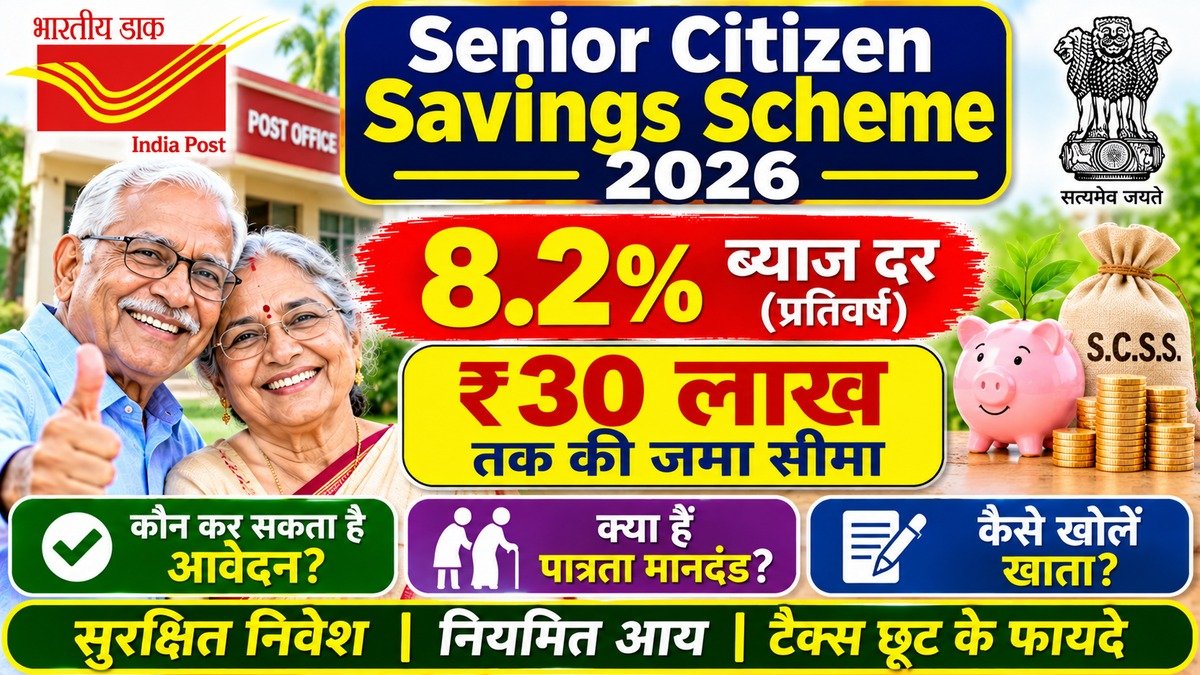
    The Senior Citizen Savings Scheme (SCSS) is a Government of India savings option designed to provide regular income to eligible retirees. For the October–December 2026 quarter, it offers 8.2% annual interest, paid quarterly. Eligible individuals can deposit between ₹1,000 and ₹30 lakh. The normal account term is five years, with the option to extend it in further three-year blocks under the amended rules.

    What is the Senior Citizen Savings Scheme?

    The Senior Citizen Savings Scheme is a government-backed small-savings product operated through post offices and authorised banks.

    It is designed mainly for people who have retired and want a regular income from their savings. Unlike a market-linked investment, the interest rate is notified by the government for each quarter.

    The scheme is governed by the Senior Citizens’ Savings Scheme, 2019, and its subsequent amendments. It is active in 2026. India Post currently lists the scheme and its 8.2% interest rate on its official savings page. India Post+1

    Senior Citizen Savings Scheme interest rate in 2026

    The rate for the third quarter of financial year 2026-27 is:

    8.2% per annum

    Applicable from 1 October to 31 December 2026

    The Ministry of Finance kept small-savings interest rates unchanged for this quarter through its notification dated 30 September 2026.

    Interest is paid every quarter. It is not automatically added to the deposit to earn further interest within the SCSS account. The rate applicable when the account is opened remains relevant for its initial five-year term. Department of Economic Affairs+2

    How much interest can you receive?

    Here are examples using the current 8.2% annual rate:

    DepositApproximate quarterly interestAnnual interest
    ₹5 lakh₹10,250₹41,000
    ₹10 lakh₹20,500₹82,000
    ₹20 lakh₹41,000₹1,64,000
    ₹30 lakh₹61,500₹2,46,000

    These figures are simple calculations using the notified annual rate. Actual payment timing and the first interest instalment may depend on the account-opening date. Interest is taxable under applicable income-tax rules. India Post+1

    Senior Citizen Savings Scheme benefits

    1. Regular quarterly income

    The main benefit is the regular interest payment. The interest can be credited to the linked savings account, helping the account holder meet regular household expenses.

    2. Government-backed savings

    The scheme operates under government small-savings rules. Its interest rate is notified by the government, rather than being linked to daily stock-market movements.

    3. Deposit limit of ₹30 lakh

    The minimum deposit is ₹1,000, and the maximum total deposit is ₹30 lakh per eligible individual across all SCSS accounts.

    You cannot multiply the limit by opening accounts at different banks and post offices. The combined deposit must remain within the permitted ceiling. uat.indiapost.gov.in+1

    4. Five-year term with extension options

    The standard account runs for five years. Under the 2023 amendment, the account can be extended in further blocks of three years. You must apply within one year of maturity or the end of an extension block.

    The extended account earns the rate applicable on the date of maturity or extended maturity. An extended account closed within one year of extension attracts a 1% deduction from the deposit. dhenkanalpostaldivision.org

    Who can open a Senior Citizen Savings Scheme account?

    The main eligibility categories are:

    • A resident Indian who has completed 60 years of age.
    • A retired civilian employee aged 55 or above but below 60, subject to the retirement-benefit conditions.
    • A retired defence-services person aged 50 or above, excluding civilian defence employees, subject to the prescribed conditions.
    • Certain spouses of eligible government employees who died in service, subject to the special rules.

    For eligible civilian retirees aged 55 to below 60, the account must be opened within three months of receiving retirement benefits. Proof of the retirement benefits and an employer certificate are required.

    A joint account can be opened with the spouse. The first account holder’s age is used to determine eligibility, and the full deposit is counted against that person’s deposit limit. dhenkanalpostaldivision.org+1

    Documents required for SCSS

    Keep these documents ready:

    • Aadhaar card.
    • PAN card.
    • Proof of age or date of birth.
    • Two recent passport-size photographs.
    • Address and identity details.
    • Savings bank account details for receiving quarterly interest.
    • Retirement certificate and proof of retirement benefits, if applying under an early-retirement category.
    • Completed SCSS account-opening form.

    The post office or authorised bank may ask for additional KYC documents. Carry the originals for verification along with photocopies. indiapost.gov.in+1

    How to open a Senior Citizen Savings Scheme account

    You can open an account through a post office or an authorised bank.

    Step 1: Check your age and eligibility. Confirm that you meet the normal age requirement or one of the prescribed retirement exceptions.

    Step 2: Calculate your deposit. Make sure your combined SCSS deposits will not exceed ₹30 lakh.

    Step 3: Visit a post office or authorised bank. Ask for the Senior Citizen Savings Scheme account-opening form.

    Step 4: Choose single or joint holding. A joint account is permitted with the spouse under the scheme rules.

    Step 5: Complete the form. Enter the personal details, nominee information, deposit amount and bank details.

    Step 6: Submit your KYC documents. Attach your Aadhaar, PAN, age proof, photographs and other applicable records.

    Step 7: Deposit the money. Make the initial deposit using an accepted payment method. India Post’s guidance states that cash deposits are accepted up to ₹1 lakh; larger deposits should be made by cheque or electronic transfer.

    Step 8: Check the account details. Confirm that the deposit amount, name, account type and linked savings account are correct.

    Step 9: Collect the account proof. Keep the passbook or deposit acknowledgement safely.

    Step 10: Monitor quarterly interest. Check that the interest is credited to the correct savings account. indiapost.gov.in+1

    Premature closure: what should you know?

    SCSS is designed for a five-year period. Closing it early can reduce the interest you receive.

    The general rules include:

    • Closing before one year: interest already paid is recovered from the deposit.
    • Closing after one year but before two years: 1.5% of the deposit is deducted.
    • Closing after two years but before five years: 1% of the deposit is deducted.
    • Closing an extended account within one year of extension: 1% of the deposit is deducted.

    An extended account can be closed after one year from the extension date without that deduction. Review your expected cash needs before investing. nsiindia.gov.in+1

    Common mistakes to avoid

    • Depositing more than the ₹30 lakh individual limit.
    • Assuming the interest rate will remain the same after maturity and every extension.
    • Opening a joint account with someone other than a spouse.
    • Missing the three-month window for an eligible early-retirement application.
    • Forgetting to provide PAN or age proof.
    • Assuming quarterly interest is tax-free.
    • Ignoring premature-closure deductions.
    • Leaving a matured account unattended instead of closing or extending it.

    Do not invest emergency funds in a five-year account if you may need the money soon.

    An illustrative example

    Suppose a 63-year-old retired person deposits ₹10 lakh in SCSS during the October–December 2026 quarter.

    At the notified 8.2% rate, the approximate quarterly interest is ₹20,500. Over a full year, the interest works out to ₹82,000 before tax.

    The original deposit remains subject to the five-year term and the scheme’s closure rules. This example is an illustration, not a promise of a particular tax outcome.

    Frequently asked questions

    1. What is the current SCSS interest rate?

    It is 8.2% per year for accounts opened during October–December 2026.

    2. What is the maximum deposit?

    The maximum aggregate deposit is ₹30 lakh per eligible individual across SCSS accounts.

    3. Can a person aged 58 open an SCSS account?

    A retired civilian employee aged 55 to below 60 may qualify if the retirement and three-month investment conditions are met. Defence retirees have separate age rules.

    4. Can I extend the account after five years?

    Yes. The 2023 amendment allows further three-year extension blocks, subject to the application window and scheme conditions.

    5. Is SCSS interest taxable?

    Yes. Interest is taxable under the applicable income-tax rules. Check the current tax regime and TDS requirements before calculating your net income. dhenkanalpostaldivision.org+2

    Open an account through an authorised channel

    Check the latest rules and your deposit limit before visiting a post office or authorised bank. For current rates and scheme details, visit the official India Post savings schemes page.

  • Salmonella Outbreak Linked to Jalapeño Peppers from Mexico: 488 Illnesses Evaluated Across 34 U.S. States

    Salmonella Outbreak Linked to Jalapeño Peppers from Mexico: 488 Illnesses Evaluated Across 34 U.S. States

    Overlook

    A multistate outbreak of Salmonella Javiana infections in the United states(US) linked to contaminated jalapeño peppers imported from Sinaloa, Mexico, and distributed by Coast Citrus Distributors. The investigation, conducted by the U.S. Food and Drug Administration (FDA), Centers for Disease Control and Prevention (CDC), and state and local public health authorities, reported 488 illnesses across 34 states.

    CDC’s final investigation update published on October 2, 2026, the outbreak resulted in 65 hospitalizations and no reported deaths, thankfully. The agency officially declared the outbreak over after reviewing epidemiological, laboratory, and food-traceback information.

    The infected jalapeño peppers supplied to wholesalers, restaurants, food distributors, and food service companies in US. Numerous businesses subsequently initiated additional recalls after using the affected peppers as ingredients in prepared foods, sauces, dips, and other products such as salsa,guacamole, etc.

    How the Salmonella Outbreak Was Identified

    Salmonella Outbreak

    The investigation identified jalapeño peppers imported from Sinaloa, Mexico, and distributed by Coast Citrus Distributors as the likely source of the outbreak.

    Health authorities collected epidemiological information from people who became ill and examined their food consumption histories. Among 308 individuals interviewed, 281 (91%) reported eating at a Mexican-style restaurant during the week before becoming ill.

    The restaurants mentioned in the investigation included Chipotle Mexican Grill and QDOBA. Investigators identified 36 illness clusters associated with 31 Chipotle locations across seven states and five QDOBA locations across two states.

    Coast Citrus Distributors Initiates Jalapeño Recall

    Coast Citrus Distributors initiated recall actions to remove potentially contaminated jalapeño peppers from the supply chain.

    On July 22, 2026, the company initiated a limited recall involving jalapeño peppers packaged in bulk generic Coast Tropical packaging.

    On August 5, 2026, the company agreed to recall the remaining jalapeños imported from Sinaloa, Mexico, that were implicated through epidemiological and traceback information.

    USDA Issues Additional Public Health Alert for Meat and Poultry Products

    The U.S. Department of Agriculture’s Food Safety and Inspection Service (FSIS) also issued a public health alert on August 8, 2026.

    The alert concerned various meat and poultry products containing FDA-regulated jalapeños that had been recalled because of potential Salmonella contamination.

    The agency warned that affected products could remain in household refrigerators, freezers, or retail establishments. Consumers were advised not to consume products identified in the alert, while retailers were instructed not to sell or serve them.

    Importantly, FSIS reported that there were no confirmed illnesses associated with consumption of the FSIS-regulated meat and poultry products containing the affected jalapeños at the time of its announcement.

    Symptoms and Health Risks of Salmonella Infection

    Salmonella is a foodborne bacterium that can cause an intestinal infection known as salmonellosis. People generally develop symptoms within 12 to 72 hours after consuming contaminated food.

    Common symptoms include:

    • Diarrhea
    • Fever
    • Abdominal cramps

    Symptoms generally last four to seven days, and many infected individuals recover without specific medical treatment.

    However, severe infections can occur, particularly among young children, older adults, and individuals with weakened immune systems. Anyone experiencing concerning symptoms after consuming a potentially affected product should contact a healthcare professional.

    The CDC also reported that laboratory analysis identified predicted antimicrobial resistance in samples from three individuals. These findings may be relevant to treatment decisions if antibiotics are required, although most people with Salmonella infections recover without antibiotic treatment.

    Current Investigation Status

    As of October 2, 2026, the CDC declared the multistate Salmonella Javiana outbreak linked to jalapeño peppers from Sinaloa, Mexico, over. The FDA also closed its outbreak investigation.

    The recalled fresh jalapeños distributed by Coast Citrus Distributors are no longer for sale and are past their shelf life, according to the FDA. However, some downstream products made using the affected peppers may have longer shelf lives, making it important for consumers to check the consolidated recall information.

    Although investigators identified a common grower in Sinaloa as the likely source, the FDA reported that it could not determine the specific route or source of contamination during its investigation.

    The outbreak highlights the importance of food traceability, supplier verification, microbiological surveillance, and coordinated recall procedures throughout the food supply chain.

    Conclusion

    The 2026 Salmonella Javiana outbreak associated with jalapeño peppers imported from Mexico resulted in 488 reported illnesses and 65 hospitalizations across 34 states. Although the CDC has declared the outbreak over, the associated product recalls remain important for consumer awareness and food safety.

  • Hello world!

    Welcome to WordPress. This is your first post. Edit or delete it, then start writing!